Google

What is Macedonia?

Monday, March 24, 2008

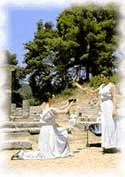
Flame ceremony and 2nd Delphic Hymn to Apollo

When, in 1894, Baron Pierre de Coubertin (1863-1937) convened an international athletic conference at the Sorbonne, his intention was to promote among the participants the idea of reviving the Olympic Games. Moreover, it was not by chance that at the conclusion of the first day (16 June) of the conference, de Coubertin chose to have the first Delphic Hymn to Apollo.

The hymn had been discovered at Delphi only a year before by the French School of Archeology. Knowing of the importance of this discovery, the organizers took the best advantage of it. It offered an opportunity to combine athletics and the theme of the conference with Ancient Greece and with the central concepts of the Olympic Games, i.e., the ideals of friendship and the noble competition among nations.


Εἲς ̓Απόλλωνα

φοι̂βε, σὲ μὲν καὶ κύκνος ὑπὸ πτερύγων λίγ' ἀείδει, ὄχθῃ ἐπιθρώσκων ποταμὸν πάρα δινήεντα, Πηνειόν: σὲ δ' ἀοιδὸς ἔχων φόρμιγγα λίγειαν ἡδυεπὴς πρω̂τόν τε καὶ ὕστατον αἰὲν ἀείδει.

καὶ σὺ μὲν οὕτω χαι̂ρε, ἄναξ, ἵλαμαι δέ σ' ἀοιδῃ̂.

Sunday, March 9, 2008

The Editor The Times 1, Pennington Street London E98 1TA Friday, 7th March 2008

Written by Angela Carras President The Macedonian Society of Great Britain.

Dear Sirs,

Following the placement of a two-page advertisement in The Times (as well as other newspapers in Europe) on Thursday 6th February 2008 by the government of the former Yugoslav Republic of Macedonia (FYROM) I feel obliged to point out that the advert is purposely misleading and could therefore be described as propaganda. It is implied that the Hellenic Republic is objecting to their membership of NATO unjustly and in contravention of the Interim Accord signed in 1995. However it is clearly stated in Article 11 of that agreement that the Hellenic Republic reserves the right to object if an application of membership is made under any name other than “the former Yugoslav Republic of Macedonia” as defined in UN Security Council Resolution 817 (1993).

By having signed the interim accord, it can be inferred that FYROM accepted that there was a valid reason for the naming dispute. Common sense dictates that for this matter to be resolved requires the adoption of alternatives to their constitutional name “Republic of Macedonia” and the short form of “Macedonia”. Since their government refuses to accept any alternative name in international relations, it is their own doing that Hellenic government is forced to veto their entry to NATO, despite that being in against the military and socio-economic interests of the Hellenic Republic itself.

I would also like to take this opportunity to address their proposal to adopt an alternative name to be used ONLY in direct relations with the Hellenic Republic. This is clearly a preposterous solution since it in no way resolves the essence of the dispute, which is that of exclusive claim to the name Macedonia.

I am a Macedonian and the President of the Macedonian Society of Great Britain. I was born in Thessaloniki, the capital of the province of Macedonia in Greece. Thessaloniki is an ancient city named after the half-sister of Alexander the Great. He is the national hero who personifies the glory of Ancient Macedonian history, and a hero of the entire Greek speaking population since he conquered a huge empire to which he spread the Greek language and civilisation. We are proud of this achievement much like the British are proud of their own past empire which spread their influence and civilisation. I am a Macedonian, however I am in no way identified with or related to the newly formed independent state referred to as “the former Yugoslav Republic of Macedonia” ; I am instead insulted by the fact that I cannot be known as a Macedonian without being identified by others as related to FYROM. My identity has been usurped. “Where is the justice ?”, to paraphrase their own words.

Why is it so unacceptable for FYROM to be internationally known by a name which differentiates them either geographically or by their Slav ethnicity ? Geographically speaking the territory that falls within their sovereignty is only the northern part of the region historically known as Macedonia. In fact the largest part of their country has only been referred to as Macedonia since the 1950s, previously being called Vardarska Banovina as part of the Kingdom of Yugoslavia.

The Hellenic Republic is definitely not hostile and is evidently very willing to have good relations with its neighbour and promote trade and business. Every effort has been made to help resolve this issue without sticking to untenable positions and taking a pragmatic approach. However in the meantime FYROM has promoted the use of the names “Republic of Macedonia” and “Macedonia” and this has done nothing but make the situation more difficult to resolve. My only hope is that when an alternative name is finally adopted internationally, since that is the only possible resolution to this issue, that the media will promote it and that this issue will be finally laid to rest.

Yours faithfully,

Angela Carras President The Macedonian Society of Great Britain

Interim Accord signed in New York in 1995 Article 11 1. Upon entry into force of this Interim Accord, The Party of the First Part agrees not to object to the application by or the membership of the Party of the Second Part in international, multilateral and regional organizations and institutions of which the Party of the First Part is a member ; however, the Party of the First Part reserves the right to object to any membership referred to above if and to the extent of the Party of the Second Part is to be referred to in such organization or institution differently than in paragraph 2 of the United Nations Security Council resolution 817 (1993).

UN Security Council Resolution 817 (1993) Paragraph 2 Recommends to the General Assembly that the State whose application is contained in document S/25147 be admitted to membership in the United Nations, this State being provisionally referred to for all purposes within the United Nations as "the former Yugoslav Republic of Macedonia" pending settlement of the difference that has arisen over the name of the State ;

Saturday, March 8, 2008

Alexander The Film

Slavoskopians remember Alexander's words on this movie scene :

"FOR THE FREEDOM AND GLORY OF GREEEEEEEEEEECE"

Geece VETO FYROM

SlavoSkopians (ex-Bulgarians) workers put up a sign displaying the new name of the SlavoSkopian's main airport, Aleksandar Veliki (in Bulgarian SlavoSkopian dialect instead of ΑΛΕΞΑΝΔΡΟΣ Ο ΜΕΓΑΣ in Macedonian language), near the SlavoSkopian capital Skopje (from Skhip in Albanian means Eagle), on January 16. Fyrom's decision to rename its main airport after the ancient Greek conqueror Alexander the Great, added fuel to a 15-year-old dispute with neighbouring Greece over the former's name.


The US urges direct talks on the name dispute, as most Greeks reject Skopje's admission to Nato until a compromise can be reached

If the world was focused on US President George Bush's resounding call for Kosovo independence during his June 9 visit to Albania, Greece was equally focused on its dispute with the Former Yugoslav Republic of Macedonia (Fyrom) on that country's name.

The two issues are linked by the intention of the US to shepherd Fyrom, Albania and Croatia into Nato early next year. Bush held a joint meeting with the leaders of all three countries during his brief stay in Tirana.

US Undersecretary of State Nicholas Burns, a former ambassador to Athens, addressed Greek concerns about the name dispute when he arrived in Athens one day after Bush's visit to Albania.

He was welcomed by a fresh poll indicating that an overwhelming 83.3 percent of Greeks want the government to veto Fyrom's Nato entry under its constitutional name: Republic of Macedonia. But nearly two-thirds (61 percent) object to the country's membership, even with the name Fyrom. Nato is expected to review Fyrom's application early next year, and Greece has recently appeared eager to resolve the name dispute beforehand.

Fyrom not ready for Nato

Burns urged calm on the name dispute during a briefing for journalists, where he noted that no decision will be taken on Fyrom until early 2008. Indeed, Fyrom has yet to institute many of the reforms required for Nato membership (which also applies to Albania, as Bush noted while in Tirana).

Greece is eager for each Nato candidate to be judged on its merits, rather than be shepherded in as a group. Croatia is the only candidate that has now met the criteria, and the period needed for Fyrom to institute reforms could also buy time to reach a settlement on the name dispute.

But Burns expressed support for the bilateral talks at the UN to resolve the name issue, and he urged the two sides to step up direct contacts to that end. He also underlined the need for more reforms before Skopje is ready for Nato membership.

Burns said that Washington has made clear to Fyrom that it understands the "sensitivities" of Nato ally Greece, and that it wants a mutually acceptable solution to be reached. The US recognised Fyrom as Republic of Macedonia in 2004.

Athens' eagerness to resolve the dispute is, in part, explained by US Secretary of State Condoleezza Rice's expression of Washington's support - in a letter to Fyrom Foreign Minister Antonio Milososki a few months ago - for Fyrom's entry even if the name dispute with Greece cannot be resolved by the time it is ready for membership. That would deprive Greece, a member of Nato and the EU, of one of its two pillars of leverage to push a mutually acceptable compromise.

Compromise before admission

Greece recently rejected Fyrom President Branko Crvenkovski's suggestion, in an interview with the daily Kathimerini, that his country could live with entering Nato under the name Fyrom, at least as an interim measure.

Foreign ministry spokesman George Koumoutsakos described that stance as a "useless tactical move". Koumoutsakos said that Fyrom's Euro-Atlantic path (Nato and EU membership) depends on its "conciliatory and moderate" stance in bilateral talks under UN auspices (led by mediator Matthew Nimetz) to reach a mutually acceptable solution. He also called on Skopje to abandon irredentist policies and acts (such as the recent move to name the Skopje airport after Alexander the Great). The spokesman also accused Skopje of violating the 1995 interim agreement under which the name Fyrom is to be used in all international organisations.

Greek diplomats are today bracing for a visit by the chief of NATO following a breakdown in talks between Greece and the Former Yugoslav Republic of Macedonia (FYROM) that had been aimed at solving the Macedonia name dispute.

NATO Secretary-General Jaap de Hoop Scheffer is expected to exert pressure on the government to reach a compromise with FYROM ahead of a NATO summit scheduled for April when the Balkan state's accession to the alliance is to be discussed. But Greece also faces pressure on the domestic front, according to the results of an opinion poll, conducted by Public Issue for Kathimerini, which shows that 84 percent of people want the government to veto FYROM's NATO accession if a mutually acceptable solution to the name dispute is not reached.

The two diplomats representing Greece and FYROM returned home empty-handed after Saturday's negotiations with a UN mediator in New York failed to reach a breakthrough. The UN's Matthew Nimetz spoke of «substantive differences» between the two sides. He is now expected to take a back seat as the US applies pressure on both Athens and Skopje to reach a solution ahead of next month's summit. According to sources, US President George W. Bush will telephone Greek Prime Minister Costas Karamanlis and FYROM's Branko Crvenkovski.

Before boarding his flight to Athens, Scheffer said that he had discussed the name issue with Bush and would brief Karamanlis and Foreign Minister Dora Bakoyannis on the president's stance.

According to sources, Scheffer will probably stress Greece's obligations as a NATO member state and object to the country's negative stance on the two main topics on the agenda of next month's summit, namely the alliance's enlargement and the recognition of Kosovo as independent.

It is unclear whether the US will propose anything in the framework of the name talks.

Greece had declared itself ready to discuss one of the five composite names proposed by Nimetz. But FYROM rejected all five suggestions.

Russia's Ambassador to Greece Andrei Vdovin told Sunday's Kathimerini that his country would be willing to adopt whichever new composite name is agreed upon for FYROM even though it recognized the Balkan state by its constitutional name in 1992. «In view of Greece's concerns and with the aim of securing stability in the Balkans. ...(Russia) will accept whichever settlement meets the criteria (of a mutually acceptable solution),» Vdovin said. Moscow would be ready to use the new name in its bilateral relations with FYROM, he added.

Last week the US ambassador in Athens, Daniel Speckhardt, avoided commenting on whether Washington would adopt the new name - once it is has been agreed - in its bilateral dealings with FYROM.

Eight in 10 back veto option

Eight in 10 Greeks feel that the government should veto FYROM's bid to join NATO and the European Union if the two sides cannot resolve the name dispute, according to a poll conducted by Public Issue on behalf of Sunday's Kathimerini.

With a rally planned in Thessaloniki on Wednesday, 36 percent of those questioned said they would «definitely» take part in a public protest about the name issue. Another 16 percent said they would «probably» take to the streets.

However, only a quarter of Greeks believe that FYROM is a «big» or «very big» threat to Greece's security. The same percentage think that it would be a «national catastrophe» if Greece's neighbor is recognized as Macedonia.

The diplomatic process is due to continue but almost half of Greeks feel that Athens is fighting a losing battle.

The poll suggests that 48 percent feel that the government can win its diplomatic battle to ensure that the neighboring state does not call itself «Macedonia.» But exactly the same percentage of respondents feel that, with almost 120 countries now recognizing the Balkan state as «Macedonia,» Greek efforts will probably prove futile.

The only name that anywhere near the majority of Greeks seem willing to accept is «Democratic Republic of Upper Macedonia» - 43 percent of some 600 respondents questioned last week said that they would «definitely» or «probably» accept this name.


Fyrom is also the name with which Skopje was admitted to the United Nations and under it has applied for Nato membership. Though most countries have already recognised Fyrom under its constitutional name, Greece objects to Skopje's use of the name Macedonia on the grounds that it constitutes an expropriation of the name of the Greek province, which was the centre of the ancient Macedonian dynasty.

Friday, February 22, 2008

Γιορτή για τους μαθητές του φροντιστηρίου στο Μοναστήρι

Τους μαθητές του φροντιστηρίου ελληνικής γλώσσας, του πολιτιστικού συλλόγου «ΜΑΤΙ», δεξιώθηκε ο Έλληνας Πρόξενος στο Μοναστήρι της ΠΓΔΜ, την Τρίτη 5 Φεβρουαρίου 2008.
Οι μικροί μαθητές, απήγγειλαν ποιήματα και τραγούδησαν τραγούδια, που έμαθαν στη διάρκεια των μαθημάτων τους, στο φροντιστήριο ελληνικής γλώσσας, που λειτουργεί το "ΜΑΤΙ" στο Μοναστήρι.
Ο Πρόξενος της Ελλάδας, κ.Δημήτριος Παπανδρέου, συνεχάρη τα παιδιά για την πρόοδό τους στην ελληνική γλώσσα, ενώ συνομίλησε με τους γονείς που τα συνόδευαν.
Το φροντιστήριο της ελληνικής γλώσσας, λειτουργεί τα τελευταία πέντε χρόνια, με ευθύνη του ομογενή κ.Αθανάσιου Στεργίου. Απο τις τάξεις του, έχουν περάσει μέχρι σήμερα περισσότερα απο 200 παιδιά, ελληνικής καταγωγής. Τα μαθήματα πραγματοποιούνται στο διαμέρισμα του κ.Στεργίου (φωτογραφία), αφού ο σύλλογος δεν διαθέτει, μέχρι στιγμής, δικό του χώρο.

SlavoSkopians welcome to Macedonia

As Macedonian I would like to welcome every SlavoSkopian (ex-Bulgarian) that want to be named as Macedonian to join the Macedonia people.

SlavoSkopian if you want to be Macedonians you need just to love Macedonia.

Reject your Bulgarian names, your Bulgarian heroes in your national anthem (Mirsikov, Tartchaeff...) who explicitly declared themshelves as Bulgarians, reject your Turkish-Slav toponyms and adopt the Macedonian ones.

Iksandar or Alexandros? Solun or Thessaloniki?

And don't forget to learn Macedonian history:

"And Macedonia, of course, is a part of Greece." (Strab. VII, Frg. 9)

"Tell your king (Xerxes), who sent you, how his Greek viceroy (Alexander I) of Macedonia has received you hospitably." (Herod. V, 20, 4)

"Now, that these descendants of Perdiccas are Greeks, as they themselves say, I myself chance to know." (Herod. V, 22, 1)

"But Alexander (I), proving himself to be an Argive, was judged to be a Greek; so he contended in the furlong race and ran a dead heat for first place." (Herod. V, 22, 2)


SlavoSkopians welcome to Macedonia!

Ανεξιθρησκεία ή Θεοκρατία;

Καταδίκη της Ελλάδας για τον χριστιανικό όρκο στα δικαστήρια

Η υποχρέωση του όρκου ενός πολίτη στα ποινικά δικαστήρια ή σε άλλη δημόσια ακρόαση συνιστά παραβίαση της θρησκευτικής ελευθερίας, όπως αποφάσισε χθες το Ευρωπαϊκό Δικαστήριο καταδικάζοντας γι αυτόν τον λόγο την Ελλάδα.

Καταδίκη της Ελλάδας για τον όρκο στα δικαστήρια

Παράλληλα με αυτήν την απόφασή του το ΕΔΔΑ θεωρεί ότι ο πολίτης δεν είναι υποχρεωμένος να δηλώνει ότι είναι άθεος ή ότι η θρησκεία του δεν του επιτρέπει να ορκιστεί. Εάν εξαναγκάζεται σε κάτι τέτοιο, τότε παραβιάζεται το προσωπικό του δεδομένο που έχει σχέση με τη θρησκευτική ελευθερία.

Εν προκειμένω ο προσφεύγων είναι ο δικηγόρος κ. Θεοδ. Αλεξανδρίδης, νομικός σύμβουλος του Ελληνικού Παρατηρητηρίου των Συμφωνιών του Ελσίνκι (ΕΠΣΕ).

Στην προσφυγή του (αριθμός 19516/2006) έκανε λόγο για παραβίαση του άρθρου 9 -που έχει σχέση με την ελευθερία σκέψης, συνείδησης, και θρησκείας-, καθώς υποχρεώθηκε να αποκαλύψει σε δικαστήριο ότι δεν είναι Χριστιανός Ορθόδοξος, ενώ ο ίδιος ήθελε να ορκιστεί στην τιμή και τη συνείδησή του και όχι στο Ευαγγέλιο.

Το δικαστήριο έκανε δεκτή την προσφυγή του και αποφάσισε επίσης ότι το ελληνικό κράτος πρέπει να του καταβάλει 2.000 ευρώ για ηθική βλάβη.

Saturday, February 16, 2008

Θύμα ξυλοδαρμού από παρακρατικούς του τουρκικού προξενείου η ηρωική δασκάλα της Θράκης Χαρά Νικοπούλου

Επίθεση στη δασκάλα του Μ. Δερείου freedaynewspaper στο Φεβρουάριος 8, 2008


Τελικά, η υπόθεση της υποδιευθύντριας του μειονοτικού σχολείου στο Μεγάλο Δέρειο Χαράς Νικοπούλου δεν έχει κλείσει, αλλά δε φαίνεται και να συγκινεί κανέναν.

Χθες στις 3 τα ξημερώματα ένας κάτοικος τη χτύπησε, με αποτέλεσμα να χρειαστεί να τοποθετήσει νάρθηκα στο χέρι. Να σημειωθεί ότι η κ. Νικοπούλου παρά την άσχημη εμπειρία βρήκε το κουράγιο και μήνυσε το δράστη.
Χθες δικαζόταν το αυτόφωρο, ωστόσο, αναβλήθηκε για τη Δευτέρα, επειδή ο δικηγόρος του δράστη δεν μπορούσε να παραβρεθεί. Αλγεινή εντύπωση προκαλούν οι πληροφορίες, που θέλουν το δήμαρχο Ορφέα Βαγγέλη Πούλιο να ζητά από την κ. Νικολοπούλου να αποσύρει τη μήνυση, με το επιχείρημα ότι υπάρχει πιθανότητα να απαντήσει κι ο δράστης με μήνυση, με αποτέλεσμα να μπει και η ίδια φυλακή, ενώ το πρωί παραστάθηκε στο δικαστήριο ως μάρτυρας υπεράσπισης του ανθρώπου που της επιτέθηκε.

Η κ. Νικολοπούλου αντιμετωπίζει τους τελευταίους μήνες την επίθεση των γνωστών κύκλων, που επιθυμούν να φύγει από το χωριό. Μάλιστα τον προηγούμενο Νοέμβριο έγινε σύσκεψη στο σχολείο του Μεγάλου Δερείου στην οποία συμμετείχαν ο διευθυντής και η υποδιευθύντρια, ο προϊστάμενος του γραφείου μειονοτικής εκπαίδευσης Κωνσταντίνος Τζιώτζιος, ο συντονιστής του γραφείου Σάββας Μαραγκός και γονείς των μαθητών. Ακολούθησε άλλη μία χωρίς την παρουσία γονέων. Ο προϊστάμενος του γραφείου μειονοτικής εκπαίδευσης προτίμησε, επικαλούμενος λόγους δεοντολογίας, να μην την ανακοινώσει επισήμως τα αποτελέσματα αυτής των συσκέψεων, ωστόσο, ανεπισήμως... είχε χαρακτηρίσει άκρως ικανοποιητική την απόδοση της δασκάλας πράγμα που σημαίνει ότι της παρέχει απόλυτη στήριξη και δεν υπάρχει κανένα ενδεχόμενο απομάκρυνσής της από το σχολείο. Την απόφαση αυτή επιβεβαίωσε, πάλι ανεπισήμως και ο διευθυντής του μειονοτικού σχολείου του Μεγάλου Δερείου, ο οποίος μάλιστα είχε συνταχθεί με τους γονείς που ήθελαν να διώξουν όχι μόνο από το σχολείο, αλλά και από το Δέρρειο την κ. Νικολοπούλου. Ποιο είναι το «έγκλημα» της κ. Χαράς Νικολοπούλου, κόρης του προέδρου του Αρείου Πάγου, η οποία δεν έψαξε να βρει μια «καλή θέση», όπως θα μπορούσε, αλλά προτίμησε να πάει, μαζί με το σύζυγό της στο Μεγάλο Δέρειο -και όχι, έστω στο Μικρό Δέρειο, που ζουν και χριστιανοί- για να διδάξει γράμματα στα παιδιά; Ότι έκανε μαθήματα ελληνικών στους μαθητές. Χθες τα ξημερώματα η κ. Νικολοπούλου, ήταν μόνη στο σπίτι, ο σύζυγός της έλειπε εκτός περιοχής. Έζησε τη βία και το νόμο του... Ισλάμ, μέσα στην Ελλάδα.

Kossovo. Who's next?

The Macedonians welcome the independence of our Kossovo neighbors. Many Macedonians keep the genocide memory of their Asian Minor ancestors and condamn the brutality against Kossovars in the past. Hope for a peaceful new state near our Macedonian borders. NATO and EU must help the Kossovo population as in the past.

Who’s next?

In the very near future FYROM’s Albanians will be the majority even in the SlavoSkopian capital Skopje. I’m afraid that SlavoSkopians should have accept the Albanian independence before Albanians become majority in the country.


In the near past, Tito and his communist Serbian regime have tempted the Serbisation of FYROM's Bulgarians inhabitants by naming them Macedonians and falsifying the History. On the other hand Albanian have been discriminated again (as in Kossovo) because they are proud people and the Serbian regime have never been able to convince them to change their identity as has been the case with the Bulgarians inhabitants. FYROM's Albanians are proud of their history and origin and will be independent in the future and have common borders with Macedonia.

Saturday, February 2, 2008

Afghanistan: Death Sentence for Distributing Blog Article

The Afghan Association Blog Writers (Afghan Penlog), a community established by a group of Afghan activist bloggers, has expressed deep concern for a young journalist Sayed Parwiz Kambakhsh who was condemned to death by a local court.

He has been a reporter for Jahan-e Naw (New World) weekly and a student of journalism at Balkh University.

According to Afghan Penlog and international media, Parwez Kambakhsh was detained by the authorities on October 27, 2007 for downloading and distributing an article that he found on an Iranian weblog to friends. It spoke of women’s rights, the Quran and the Prophet Mohammed. A local court in northern Afghanistan in Mazar-e Sharif has convicted him to death for the alleged blasphemy.

Global media watchdog Reporters Without Borders say the trial was “carried out in haste and without any concern for the law or for free expression, which is protected by the constitution.”

Index on Censorship says :

Deeply conservative Afghan clerics, most of whom have never used a computer or the Internet, believe Kambakhsh himself wrote the article and therefore found him guilty of blasphemy. Because there is no clear punishment for downloading “un-Islamic” articles from the Internet, the primary court of appeal asked clerics to comment. The conservative clerics, who had not investigated the case, demanded the death penalty.

Journalist’s brother may have been target

According to CNN, many believe that Kambakhsh was actually arrested for articles his brother wrote that criticized provincial authorities. The brother, Sayed Yaqub Ibrahimi, has written numerous stories that detail human rights.

Afghan PenLog issued a statement yesterday that accused Afghan authorities of attempting to escape from the issue: “… the Afghan Ministry of Information and Culture has released a letter this afternoon that says Parwiz Kambakh was not a journalist and his case has nothing to do with the media.” Afghan Penlog is deeply concerned, and demands the immediate release of Parwiz Kambakhsh.